Mile 157
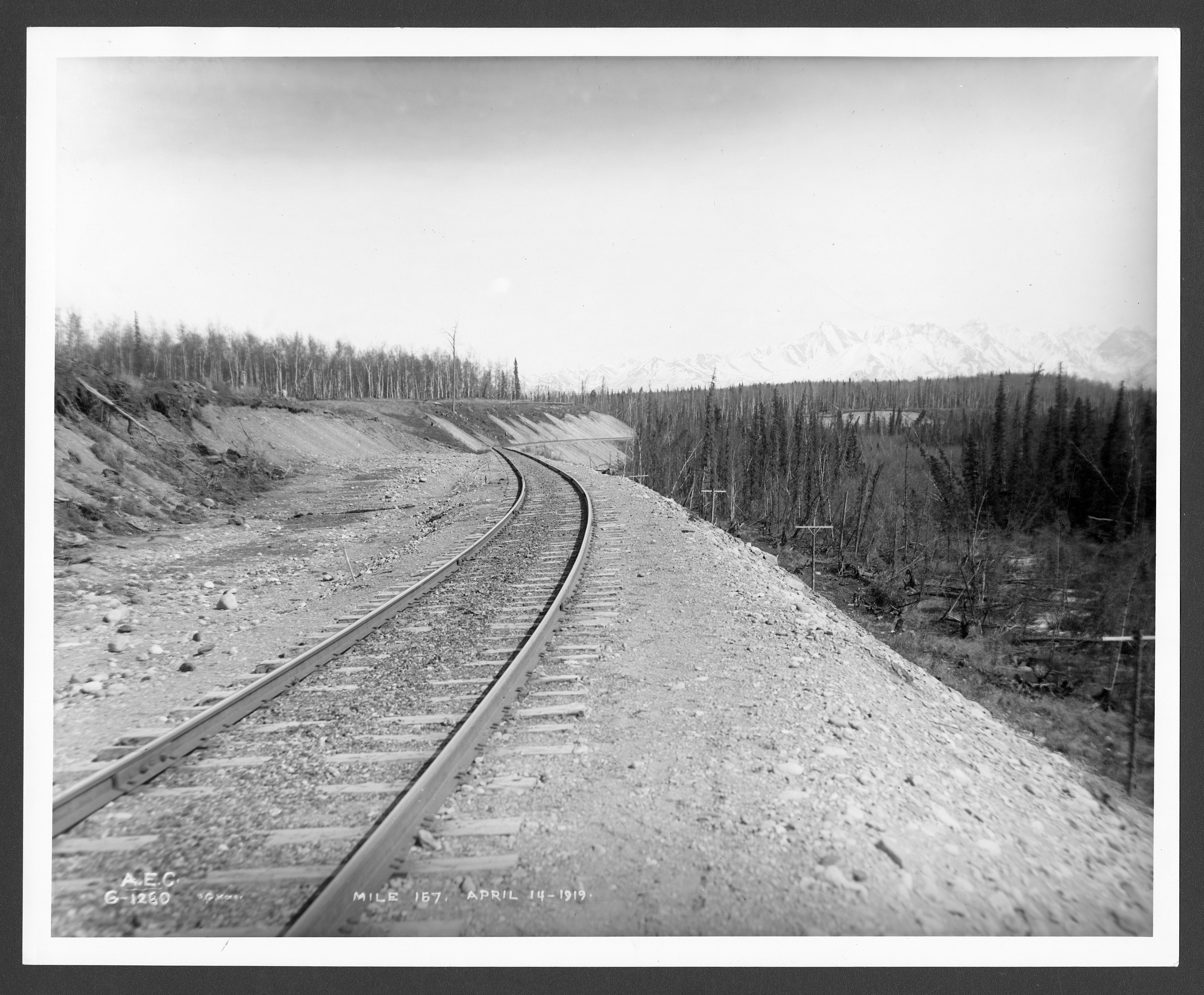
Print Photograph, Front: A.E.C. G-1260. Mile 157. April 14 - 1919. Verso: Alaska Railroad - Matanuska to Caswell, Matanuska [View down tracks, grade, mountain range in distance]


Attribution-NonCommercial-NoDerivatives 4.0 International (CC BY-NC-ND 4.0)
Print Photograph, Front: A.E.C. G-1260. Mile 157. April 14 - 1919. Verso: Alaska Railroad - Matanuska to Caswell, Matanuska [View down tracks, grade, mountain range in distance]
The development of the Alaska Railroad had a profound negative impact on Alaska Native Peoples. Although it was intended to connect communities across the state, the construction of the railroad led to an influx of new populations, the destruction of thousands of acres of pristine land, the creation of pollution where there was none, and in some cases, the diversion of waterways that disrupted salmon populations—an essential food source for Alaska Native Peoples. These destructive changes disrupted the Ahtna way of life, and their lasting effects continue to influence the work of the Tribe's Environmental Stewardship Department, which is dedicated to reversing this damage.
Development in the Matanuska Valley began in 1868 when the Alaska Commercial Company purchased all the holdings of the Russian American Company in Alaska, one year after the Alaska Purchase. As part of a calculated move, the Alaska Commercial Company established trading posts at key locations along the gulf coast of Alaska and along the Cook Inlet. Around this time, gold was first discovered on the Yukon River (in 1880); in the Cook Inlet area (in 1894); on Willow Creek (in 1897) and on the Klondike river near Dawson, British Columbia (in 1897). These discoveries led to an increase in population, mostly comprised of traders, prospectors and laborers, all wanting to be the first to take advantage of the abundant resources in the new untamed land.
The Matanuska Branch of the Alaska Railroad lies within the ancestral homelands of the Idlughet Qayeht’ana (Eklutna Village Dena’ina) and Nay'dini'aa Na' Kayax (Chickaloon Native Village). Although these lands were never ceded and are no longer under the legal ownership of either Tribe, both Tribes, along with the broader Dena'ina and Ahtna communities, work collaboratively to ensure these lands are responsibly stewarded and that their history is appropriately acknowledged.

Attribution-NonCommercial-NoDerivatives 4.0 International (CC BY-NC-ND 4.0)