
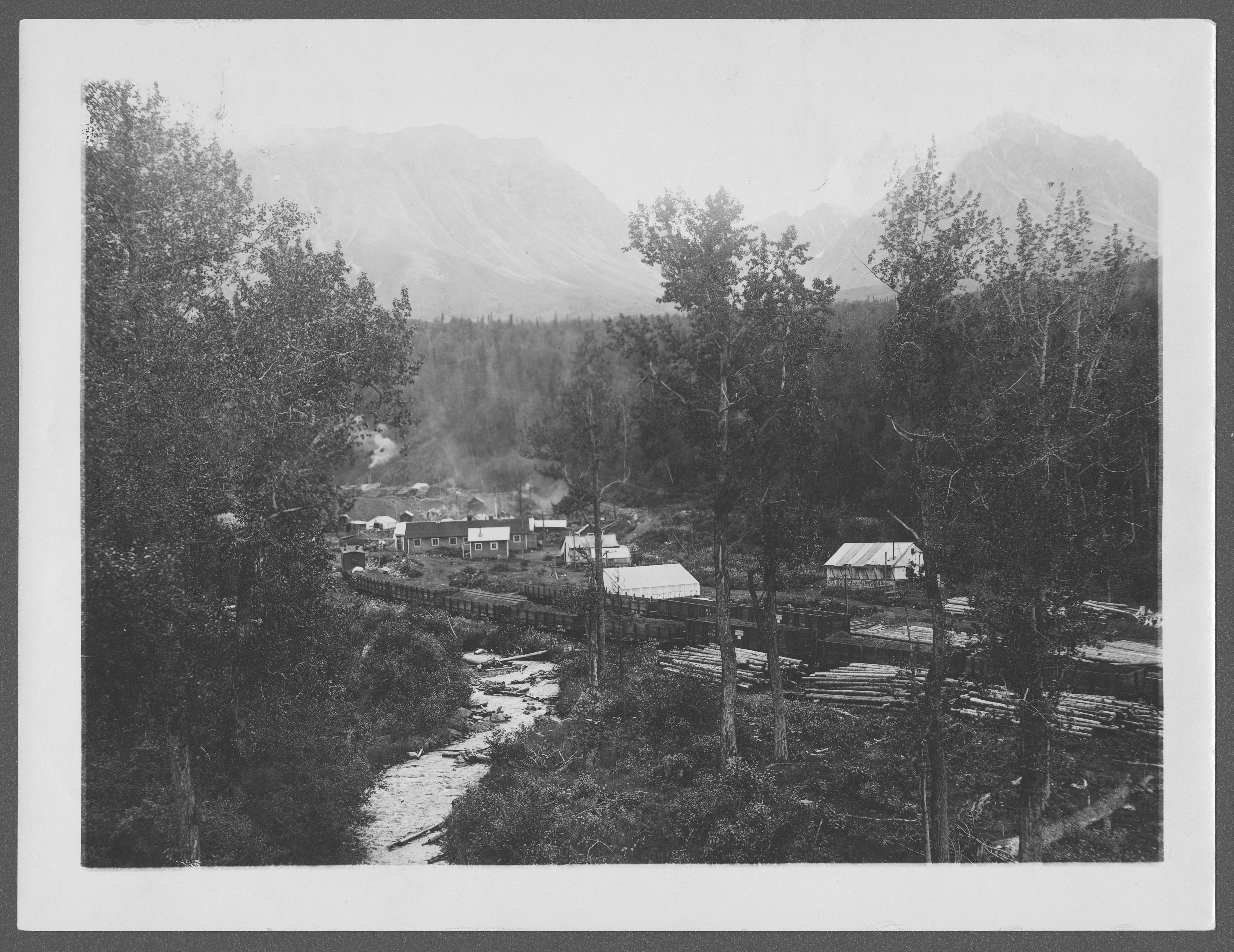
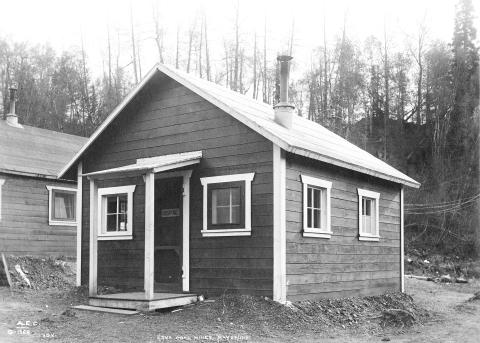
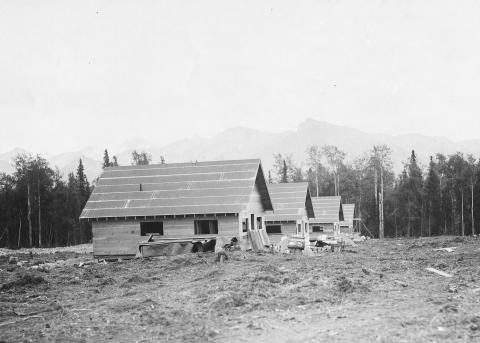
Eska Creek, Eska Mine
Print Photograph


Attribution-NonCommercial-NoDerivatives 4.0 International (CC BY-NC-ND 4.0)
Print Photograph
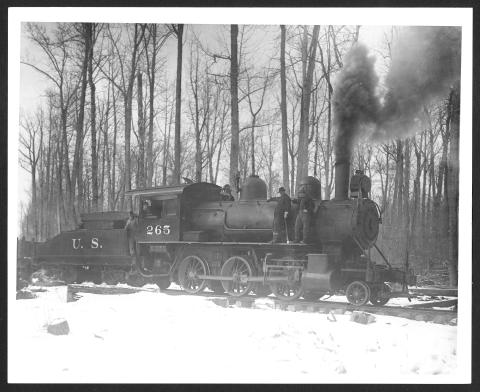
In June of 1917, to ensure that they had enough coal for their own construction and locomotive purposes, the AEC purchased the Eska Creek Mine from the Eska Creek Coal Company. On October 20, 1917, the AEC finally reached the Chickaloon field. Various spurs were constructed off the main Matanuska branch line. Among them were the Moose Creek spur, a narrow-gauged track that ran up the south side of Moose Creek, which was completed in 1923, and the Eska spur, which went up the north side of Eska Creek to the mine. Today, the town of Sutton lies where the station at the junction of the main branch and the Eska spur used to be (Bauer A History of Coal Mining 17).
From 1917 to 1918, coal was mined extensively at Eska, supplying all the needs of the AEC (Bauer A History of Coal Mining 18). It became one of the largest coal-producers in the territory from 1917 through 1920. At first, Eska Mine proved promising. The coal was nearly the quality of that found in British Columbia; so good that in Anchorage people almost mobbed the train cars, the same as they would if it was gold. The mine averaged over 150 tons of coal per day that was used to fuel locomotives, power plants and pump stations at Anchorage and Eska, as well as other places. Then came the disappointments. Mining costs proved to be higher than originally projected (from $4.50 per ton to $5.00 per ton). At about the same time the spur reached the mine, a fault sheared away a coal seam. Production plummeted. The new coal was dirty and carried a high ash content, 30 to 40 percent compared with an average for bituminous coals of 10 percent (Wilson 29). The AEC operated Eska Mine until 1920 when it became clear production was bleak and its superintendent, Evan Jones, left his position in favor of opening his own mine (Jonesville Mine) about a mile away. Not wanting to compete with a private operation, the AEC opted for closure, only opening it in times of emergency (Bauer A History of Coal Mining 26). Closing for good in 1946, the Eska Coal Mine played an important role in the growth and development of south-central Alaska.
* Wilson, William H. “The Alaska Railroad and Coal: Development of a Federal Policy, 1914-1939.” The Pacific Northwest Quarterly (1982): 66-77. Print.
The Matanuska watershed holds deep cultural significance for the Ahtna Dene. Once a rich and vibrant region, it provided an abundance of salmon, moose, and sheep, and served as a gathering place where the Ahtna met and traded with the Dena'ina. Elder Alberta Stephan recalled that the ancestral trail system near the Chickaloon River was so heavily used by Ahtna travelers that it became worn three feet deep into the earth.
The 1913 Nelchina gold rush brought a surge of non-Native travelers through the Matanuska Valley and led to the expansion of the ancestral Nay’dini’aa Na’ Kayax trail. In 1917, the federal government funded the construction of a railroad that followed this trail system, running parallel to the Matanuska River for approximately forty miles. Along with the railroad came stations, spurs, federally supported coal mines, and new settlements—all of which contributed to the widespread loss of irreplaceable cultural resources, sacred sites, and traditional knowledge.
By 1925, at least two Tribal village sites and many miles of the Nay’dini’aa Na’ Kayax ancestral trail had been destroyed, along with several salmon spawning grounds critical to Ahtna subsistence. Though much of the railroad in the Matanuska watershed was eventually abandoned by 1930, the damage to Ahtna cultural landscapes remains.

Attribution-NonCommercial-NoDerivatives 4.0 International (CC BY-NC-ND 4.0)